

Neon Atmosphere: The Science of the Sky’s Light Show
 peteythegeek@gmail.com
When the Northern Lights dance across the polar skies, they put on a show of ethereal beauty that can leave you breathless. Ribbons of green, streaks of red, and rare glimpses of purple paint the darkness, transforming the night into a living canvas. But have you ever wondered why the lights glow with these specific hues? Why green is so common, and red so elusive?
The answer lies in the incredible chemistry happening high above our heads, turning our planet’s atmosphere into a colossal, high-altitude neon sign. The colors aren’t random; they are precise chemical signatures that tell us exactly what our atmosphere is made of, and even how high up the celestial action is taking place.
The “Excitation” Phase: Setting the Stage for Light
Before we see any light, there’s an invisible cosmic ballet that has to occur. It all begins with our Sun, which constantly streams charged particles—primarily electrons—out into space as the solar wind. During a solar flare or coronal mass ejection (CME), this stream intensifies dramatically.
When these high-energy solar electrons finally collide with Earth’s protective magnetic field, many are funneled towards the poles. There, they slam into the atoms and molecules that make up our atmosphere. Imagine kicking a ball up a staircase: when an atom absorbs the energy from a colliding electron, its own electrons jump to a higher “energy level”—an “excited state.” This state isn’t stable, though. Just like the ball will eventually roll back down, the atom’s electrons quickly return to their original, lower energy levels. When they do, they release that absorbed energy in the form of a tiny packet of light: a photon.
And it’s the unique “fingerprint” of each atmospheric gas that determines the color of that photon.
Oxygen: The Master of Green and Red
Our atmosphere is primarily nitrogen and oxygen. Of the two, oxygen is the superstar of the auroral display, responsible for the most common and the most dramatic colors.
The Green Machine (60–150 miles up):
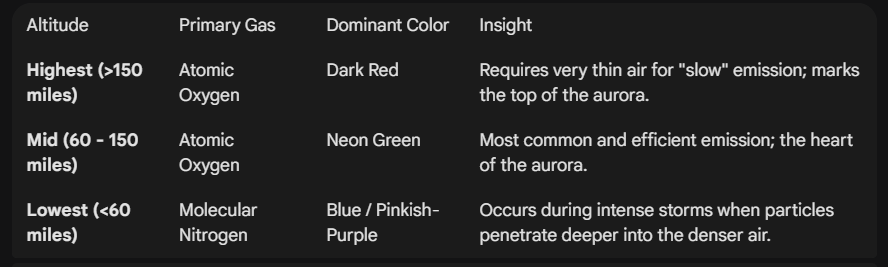
If you’ve seen photos of the aurora, chances are they were dominated by a brilliant, almost otherworldly green. This vibrant green is the signature of atomic oxygen. At altitudes roughly between 60 and 150 miles (100-240 kilometers), solar electrons frequently collide with oxygen atoms. When these oxygen atoms relax from their excited state, they emit photons with a wavelength of 557.7 nanometers—which our eyes perceive as a vivid green. This altitude range is where the balance of atmospheric density and electron energy is just right for this process, making green the most frequently observed auroral color.
The Rare Red (Above 150 miles):
While green oxygen is relatively quick to glow, red oxygen tells a different story. The deep, often elusive reds of the aurora, found at altitudes above 150 miles (240 kilometers), are also produced by atomic oxygen, but through a different “relaxation” pathway. This particular transition takes much longer—up to several minutes—for the oxygen atom to emit a red photon (at wavelengths of 630.0 and 636.4 nanometers).
Why does this matter? At lower altitudes, where the atmosphere is denser, these “slow-to-glow” excited oxygen atoms are much more likely to collide with other atoms or molecules before they can emit their red light, essentially getting their energy “quenched.” But high up in the thin, wispy reaches of the thermosphere, collisions are far less frequent. This gives the oxygen atoms enough time to finally release their red energy. So, when you witness those magnificent red auroral crowns, you’re looking at the very highest, thinnest edge of our planet’s luminous atmosphere.
Nitrogen: The Purple Fringe
While oxygen gets most of the credit, nitrogen—the most abundant gas in our air (about 78%)—also plays a crucial role, especially during intense auroral displays. Nitrogen molecules, when excited by solar electrons, typically produce blue and purplish-red light.
- The Blue Glow: When excited nitrogen ions (nitrogen atoms that have lost an electron) return to their ground state, they often emit blue light.
- The Pinkish-Purple Fringe: During very strong solar storms, when energetic electrons penetrate deeper into the atmosphere (below 60 miles or 100 kilometers), they can cause molecular nitrogen to glow with distinct pink or purplish hues, often seen as fringes at the very bottom of the auroral curtains. This is because the blue and red emissions from nitrogen mix to create these vibrant pink and purple tones.
The Altitude Gradient: A Layer Cake of Color
The different colors of the aurora are therefore not just pretty lights; they are an altitude map of our atmosphere, a celestial “layer cake” that reveals its composition:
Conclusion: A Chemical Masterpiece
The next time you gaze upon the mesmerizing dance of the Northern Lights, remember that you’re witnessing far more than just a beautiful spectacle. You’re observing a fundamental chemical process, a grand-scale interaction between the Sun’s energy and Earth’s atmospheric gases. Each flash of green, every streak of red, and every rare whisper of purple is a direct message from the atoms in our sky, revealing their identity and their altitude.
It’s a powerful reminder that our universe is a living, breathing laboratory, constantly performing experiments of breathtaking beauty right above our heads.
