

Beyond the Shadow of the Ring
 peteythegeek@gmail.com
The “Tolkien Clone” That Saved a Genre
Picture this: It’s 1977. Star Wars is blowing up the box office, punk rock is hitting the airwaves, and a book called The Sword of Shannara by a relatively unknown author named Terry Brooks makes publishing history. It became the first work of fiction, of any genre, to appear on the New York Times bestseller list. This wasn’t just a win for Brooks; it was a monumental moment that proved epic fantasy could be a commercial juggernaut, paving the way for countless fantasy sagas that followed.
Of course, when we talk about The Sword of Shannara, we can’t ignore the elephant in the room: J.R.R. Tolkien’s The Lord of the Rings. Brooks’ debut was, by his own admission, a love letter to Tolkien, a conscious homage that borrowed many familiar tropes. A mysterious, powerful druid (Allanon) guiding a humble valley-dweller (Shea Ohmsford) on a perilous quest against a dark lord from the North—the parallels were clear.
But to dismiss Shannara as merely a “Tolkien clone” would be to miss the forest for the trees. While it began with familiar beats, the series rapidly evolved into something truly unique: a massive, sprawling universe with its own distinct magic system, unforgettable characters, and a fascinating, often surprising, world-building twist. If you love the grandeur of Tolkien but are looking for a faster pace and a different kind of epic, the Four Lands are calling your name.
Popularity and Cultural Footprint
Let’s be clear: The Lord of the Rings stands as the undisputed titan of fantasy. It’s not just a series of books; it’s a foundational myth for the Western world, deeply embedded in our cultural consciousness. Tolkien’s meticulous world-building, intricate languages, and profound themes of good versus evil, sacrifice, and the corrupting nature of power set an impossibly high bar.
Terry Brooks, however, achieved something equally remarkable: he made fantasy accessible. While Tolkien is revered for his dense, academic prose and linguistic depth, Brooks became known for something else entirely—the “page-turner.” His stories are characterized by propulsive pacing, emotional, character-driven quests, and a knack for creating thrilling adventures that captivate readers from start to finish. For nearly 50 years, Brooks has been a consistent bestseller, selling tens of millions of books and bridging the gap between Tolkien’s more scholarly approach and the explosion of modern, often more commercially driven, fantasy. He proved that fantasy could be both grand in scope and intensely personal, drawing in generations of readers who might have found Middle-earth a bit daunting.
The Numbers: Books and Chronology
When it comes to sheer volume and chronological scope, both series offer immense worlds to explore. However, they approach their vastness in different ways. Tolkien’s Middle-earth is built on thousands of years of ancient history, detailed in appendices and supplementary works that flesh out the epic mythology. Brooks, on the other hand, builds outward from a central story, expanding both backward and forward in time across multiple interwoven series.
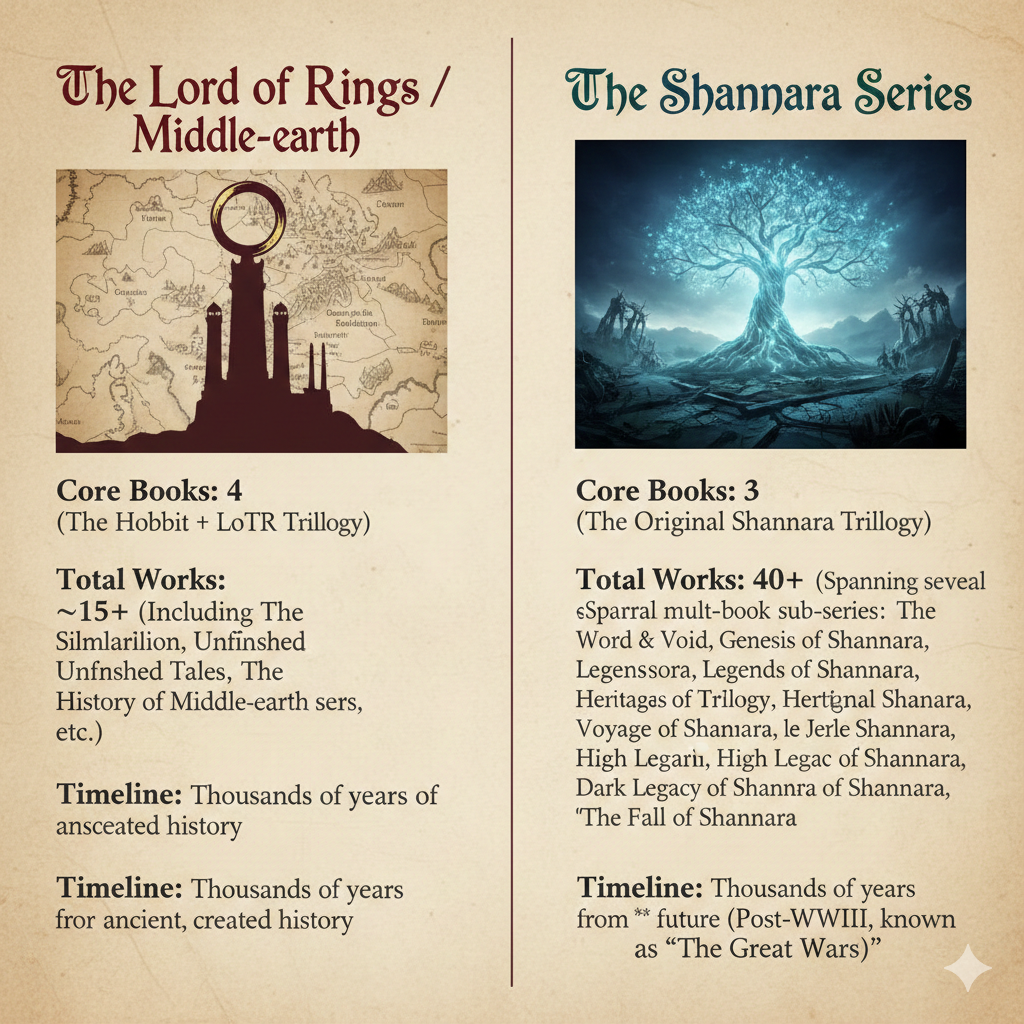
The sheer number of entries in the Shannara saga means there’s always another adventure waiting, a new generation of Ohmsfords or a new threat to confront. It’s a testament to Brooks’ enduring creativity and the depth of the world he built.
Beyond the Page: Movies and TV
Both of these legendary sagas have made their way to the screen, though with vastly different levels of impact and success.
For The Lord of the Rings, Peter Jackson’s film adaptations set a new benchmark for cinematic fantasy. These Oscar-winning movies, along with The Hobbit trilogy, translated Middle-earth’s grandeur, epic battles, and beloved characters to a global audience, becoming cultural phenomena. More recently, Amazon’s The Rings of Power series brought the Second Age of Middle-earth to television with a blockbuster budget, further expanding the visual landscape of Tolkien’s world. These adaptations are, for many, the gold standard of fantasy on screen.
Terry Brooks’ Shannara also ventured onto television with The Shannara Chronicles. Airing first on MTV and later on Spike TV, the series primarily adapted The Elfstones of Shannara, widely considered one of the best books in the saga. While it had a younger, more “YA” vibe in its presentation and cast, it was a visually impressive show. It brought the stunning landscapes of the Four Lands, the terrifying demons, and iconic elements like the magical Ellcrys tree to life for a new generation of viewers. Though it only ran for two seasons, it was a bold attempt to bring epic fantasy to a different kind of audience, showcasing the potential for Brooks’ world to thrive beyond the page. While it didn’t achieve the same critical acclaim or cultural penetration as Jackson’s LoTR, it proved that the Four Lands had serious screen appeal.
The Secret Ingredient: Fantasy vs. Post-Apocalypse
Here’s where Shannara truly carves out its own distinct identity and offers a compelling reason to dive in, especially if you think you’ve seen every fantasy trope before. While Tolkien’s Middle-earth is a meticulously crafted secondary world with its own complex creation myth, ancient races, and languages, Shannara holds a fascinating secret: it’s actually Earth.
Yes, you read that right. The Four Lands are a future version of our own planet, thousands of years after a cataclysmic global war—the “Great Wars”—decimated civilization. The “trolls” and “gnomes” aren’t creatures from another dimension, but rather mutated descendants of humanity. The “magic” isn’t a force inherent to a new world, but rather a rediscovered, misunderstood power that emerged in the wake of technological collapse.
This “post-apocalyptic fantasy” twist gives Shannara a unique flavor. It creates a sense of strange familiarity, making the world feel both alien and incredibly grounded. Ruins of old-world cities, ancient technologies misunderstood as relics of magic, and the echoes of our own history woven into the fabric of the future provide a rich tapestry that sets it apart from traditional high fantasy. It adds an intriguing layer of speculative fiction to the epic quest, making the stakes feel oddly personal and the world-building endlessly engaging.
Conclusion
If you’re a fantasy fan who cherishes Tolkien for his monumental world-building, intricate histories, and profound themes, but perhaps sometimes finds the prose a little dense or the pacing a bit slow, then Shannara is your perfect next literary adventure. Terry Brooks masterfully honors the classic epic fantasy tropes you love while constantly evolving his world, infusing it with a unique blend of magic, adventure, and post-apocalyptic wonder.
Don’t let the shadow of the Ring obscure the vibrant, expansive, and deeply engaging world of the Four Lands. It’s a saga that has captivated millions for decades, proving that a story can start with homage and grow into an unforgettable epic all its own.
Ready to start your journey to the Four Lands? Pick up The Elfstones of Shannara—often cited as the best entry point for modern readers due to its compelling plot and standalone appeal—and see why Terry Brooks has defined fantasy for generations. You might just discover your next favorite world.
